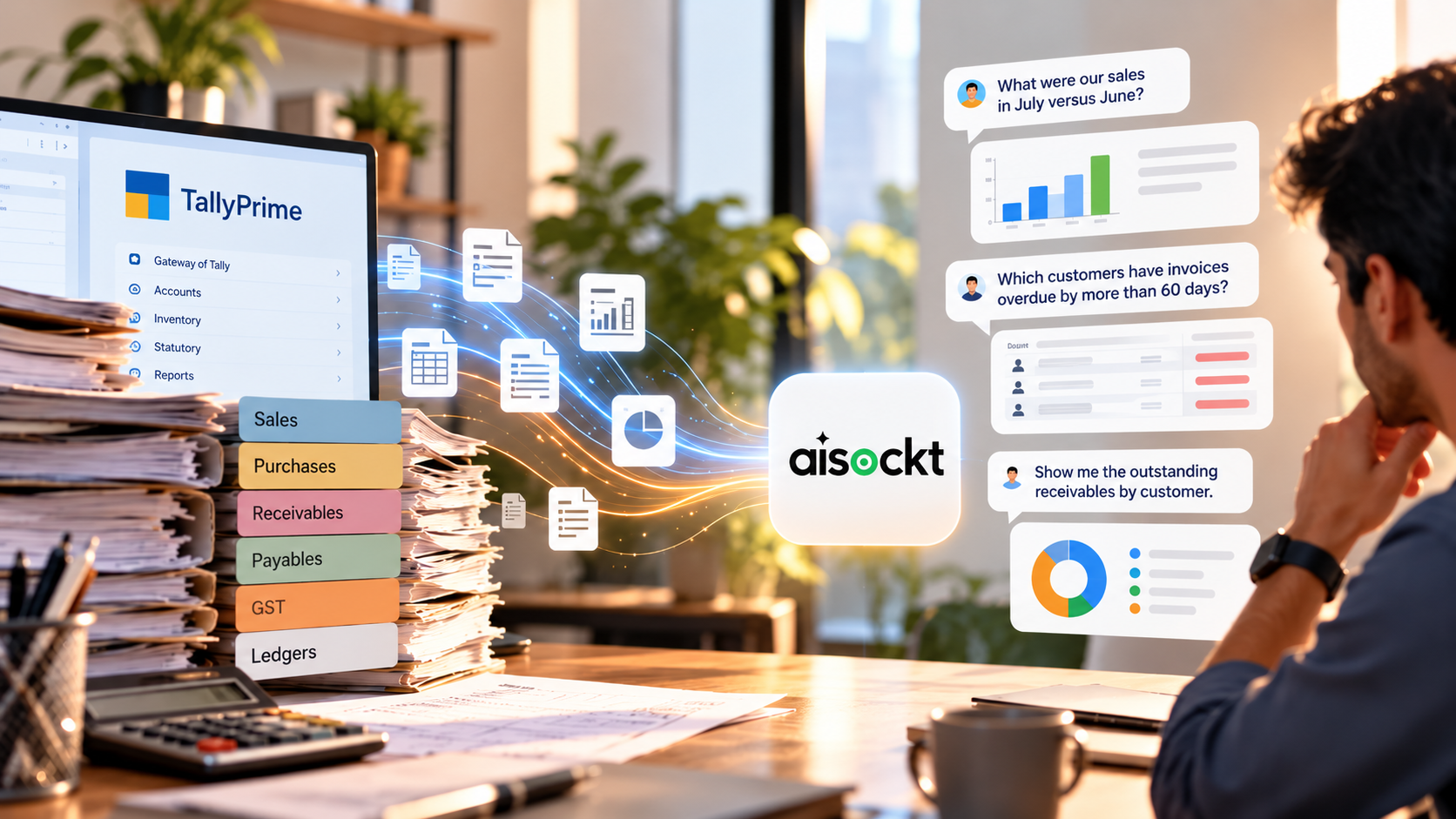

Here's something most teams don't realize until they see their first big AI bill: AI tools don't just charge you for the question you ask. They also charge you for everything you show them along the way.
That second part is the part that quietly adds up.
A simple way to think about how AI pricing works
Most AI tools charge based on how much text moves back and forth, both the text you send in, and the text the AI sends back. You can think of it a bit like a photocopier that charges by the page. It doesn't matter if you only needed to read one paragraph, if you feed the whole 200-page document through the machine so someone can find that one paragraph, you're paying for all 200 pages.
That's exactly what happens with a lot of "AI plus your business data" tools. Ask a simple question, and behind the scenes, the tool might feed hundreds or thousands of records into the AI model, just so the model can sort through them and find your answer. You end up paying for all of that reading, every single time, even though you only ever wanted one small answer.
A real-feeling example
Let's say someone on your team asks an AI assistant: "Summarize all unpaid invoices over 30 days late."
Under the common approach, here's what might actually happen behind the scenes:
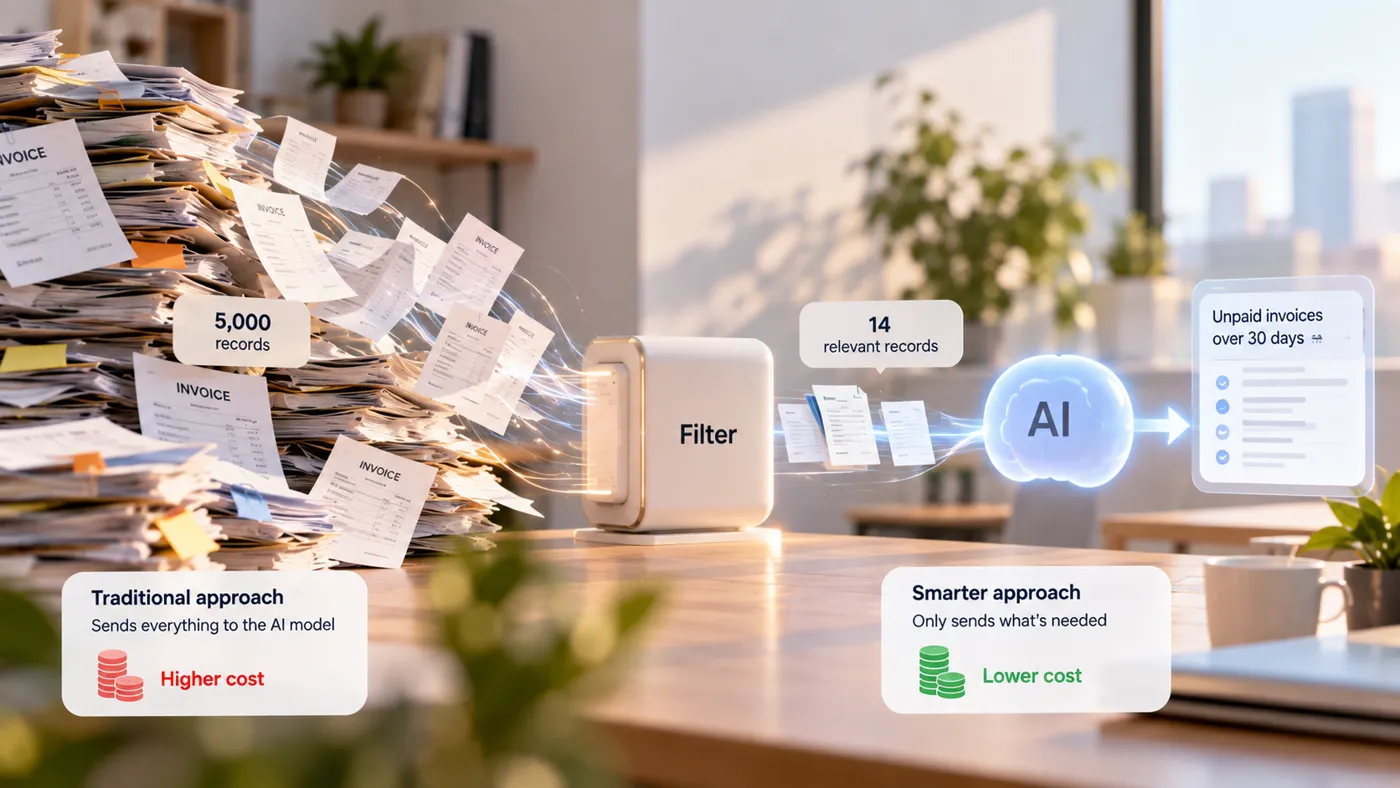
The tool pulls up your entire invoice list, let's say 5,000 records, paid and unpaid, recent and old.
All 5,000 records get sent to the AI model as one giant block of text.
The AI model reads through everything, picks out the 14 invoices that are actually overdue, and writes you a nice, short summary.
You got a short, useful answer. But behind the scenes, you paid for the AI to "read" 5,000 records to get there, not the 14 that actually mattered.
Now imagine that same question gets asked a few times a day, by different people on your team, across different reports. That "read everything, just to find a little" pattern repeats every single time. It's not one big cost, it's a small cost, over and over, that adds up much faster than most people expect.
Why this catches teams off guard
Nobody sets out to waste money this way. It happens because pulling everything and letting the AI sort through it is simply the easiest way to build these tools quickly. The team building the tool isn't trying to run up your bill, they're just taking the fastest path to a working feature.
The trouble is, "fastest to build" quietly becomes "most expensive to run," especially once a feature like this gets used by a whole team, every day, for months.
The fix: only send what's actually needed
There's a better way to handle this, and it's the same idea, whether you're thinking about cost or about privacy (which we wrote about in our last post): don't hand the AI model everything and ask it to sort through the pile. Instead, do the sorting first, and only send the AI model the small, specific answer it actually needs.
Going back to our invoice example, instead of feeding all 5,000 records to the AI model, a smarter system does the filtering before anything reaches the AI. It finds the 14 overdue invoices on its own, and only sends those 14 - not the other 4,986 - to the AI model to summarize.
Same question. Same helpful answer. A tiny fraction of the "reading," and a tiny fraction of the cost. In examples like this, the difference isn't small, it's often a 90% or greater reduction in what you're being charged for that single question, because the AI model was never handed anything it didn't need in the first place.
Why this matters for anyone planning a budget
You don't need to understand the technical details to ask the right question about any AI tool you're considering: "Does this tool send everything to the AI model, or just what's actually needed for my answer?"
If a tool can't clearly explain the difference, there's a good chance it's quietly costing you more than it needs to, and that cost will only grow as more people on your team start relying on it.
This is exactly the problem AiSockt was built to solve. By only ever sending the AI model the specific answer to a specific question, never the full pile of data behind it - AiSockt keeps your AI costs closely tied to how much you're actually asking, not how much data happens to be sitting in your systems.
Published on the AiSockt Blog, a resource for teams exploring how to use AI safely and affordably with their own business data.